Last month an opportunity to revisit Agra came my way! Once the capital of the Mughal empire of India, Agra today is a tourist magnet owing to the many majestic Mughal monuments it houses. My trip was brief, and we only managed to cover the Taj Mahal, Agra Fort, Fatehpur Sikri, and Itimad-ud-Daulah (the first three happen to be UNESCO World Heritage Sites). The Taj Mahal, a marble mausoleum built by emperor Shah Jahan for his wife Mumtaz Mahal, stands on the banks of the Yamuna river. The Agra Fort, with its august red sandstone facade, intricate layout, and lavish interiors was built over many hundreds of years by multiple monarchs, both Mughal and non-Mughal. The tomb of Itimad-ud-Daulah, built by Nur Jahan, wife of Mughal emperor Jahangir, for her parents, like the Taj Mahal, also stands on the bank of the Yamuna. Fatehpur Sikri happens to be a city under the district of Agra. The Mughal capital shifted from the city of Agra to Fatehpur Sikri during the reign of Akbar, who built this city in honor of the Sufi saint Salim Chishti after the saint's blessing supposedly gave the king his first male heir! Without further ado, the photo tour commences:
Saturday, March 23, 2013
Sunday, December 30, 2012
When Icicles Hang by the Wall
The city is draped in freshly fallen snow! It looks so pristine that it's heartwarming (although in a frosty kind of a way). I couldn't resist roaming around for some quick captures (in time before the slush takes over). Frostbitten as my fingers are, it felt delightful! Now for a cup of hot chocolate, a fuzzy blanket, and a mystery novel. What say?
| As the Bard of Avon wrote, "When icicles hang by the wall.." |
Thursday, December 27, 2012
The One World Schoolhouse
As most of us will agree, "there is an enormous difference between bemoaning the state of education and actually doing something about it." As founder of the Khan Academy, a not-for-profit organization aimed at "changing education for the better by providing a free world-class education for anyone anywhere," educator Sal Khan indubitably falls into the sparsely populated actually-doing-something category! In his book The One World Schoolhouse: Education Reimagined, he shares with us the story of how he embarked upon his remarkable expedition to transform education and his vision for the schoolhouse of tomorrow.
![]() |
| Book review: The One World Schoolhouse by Salman Khan |
Saturday, December 01, 2012
Regenesis
Thrilling as it may sound to be able to rewrite our genomes — to harness synthetic biology to transcend challenges such as disease and scarcity of food that have plagued the human race since eternity and venture into the realms of transhumanism, we are still a long way from that goal. And yet, much of this is more than just a pipe dream. In the book, Regenesis: How Synthetic Biology Will Reinvent Nature and Ourselves, Harvard professor George Church, a pioneer in the field, and co-author Ed Regis take us on a wonderful tour of synthetic biology giving us a clearer picture of what we have achieved and can achieve in the near or distant future and the tools and ideas that can take us there.
![]() |
| Book review: Regenesis by George Church and Ed Regis |
Tuesday, September 18, 2012
A Day at the Aquarium
Last Saturday I went to the New England Aquarium, which happens to be one of my favorite neighborhood destinations. Needless to say, I was armed with my new super-zoom buddy. Turns out the aquarium's central attraction, the Giant Ocean Tank, is "undergoing a top-to-bottom, 21st-century transformation." The penguins and several of their buddies are therefore on vacation. I am certainly looking forward to the makeover, which is due for completion in summer 2013! Meanwhile here are some shots, mostly of swimmers in near-perpetual motion, set in the aquarium's low-light ambience. I'm still getting used to the camera's manual mode (and clearly remain far from my target). So please do bear with me!
| "Jelly jam": Japanese sea nettles on a collision course |
Monday, September 10, 2012
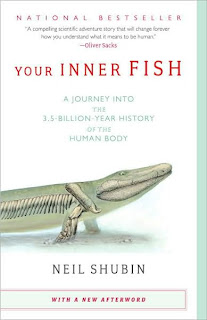
So Long, and Thanks for All the Inner Fish
Your Inner Fish: A Journey into the 3.5-Billion-Year History of the Human Body, a book with a rather curious title, traces our shared lineage with other organisms going back hundreds of years to our aquatic ancestors. Its author, Neil Shubin was a member of the team that, in 2006, discovered the purported missing link between fish and terrestrial tetrapods. It was a paleontological breakthrough that fascinated academics and laypersons alike (links: Nature and New York Times). The 375 million year old fossilized animal, excavated from the Canadian Arctic exposures, was named Tiktaalik, or "large freshwater fish" in the Inuktitut language. As a paleontologist who taught anatomy to university students, Shubin has written this wonderful book which helps us understand anatomy in light of our shared descent with the rest of the animal kingdom. According to him:
The best road maps to human bodies lie in the bodies of other animals. The simplest way to teach students the nerves in the human head is to show them the state of affairs in sharks. The easiest road map to their limbs lies in fish. Reptiles are a real help with the structure of the brain. The reason is that the bodies of these creatures are often simpler versions of ours.
Tuesday, September 04, 2012
Wildlife Safari
I have been looking for an excuse to revisit the San Diego Zoo Safari Park for a while. My renewed interest in this place was spurred by the knowledge of it being home to the only two surviving Northern White Rhinos in the world (a species I got particularly attached to after reading Douglas Adams' book Last Chance to See and watching the follow-up BBC documentary shot 20 years after the book). My PowerShot SX40 HS, which has been sitting practically unused since purchase, gave me that excuse I needed to make this long overdue visit finally happen. The SX40 is a high-end, super-zoom point-and-shoot. Most of my captures are of either distant or moving targets.
| African lion at Lion Camp enjoying his siesta |
Monday, September 03, 2012
Of Megafauna And Men
During the Pleistocene epoch, colossal relatives of many familiar present-day creatures roamed the earth. Some of these formidable megafauna species vanished abruptly (in what paleontologists like to call blitzkriegs) while some faded out gradually. Once and Future Giants: What Ice Age Extinctions Tell Us About the Fate of Earth's Largest Animals by Sharon Levy is a safari through the Pleistocene and the (ongoing) Holocene epochs acquainting us with behemoths then and now. In the author's own words:
This book tells the story of the megafauna and us. It is a tale of human coexistence and clashes with giant animals, past and present, and our responsibility toward them in the future.
Just as the struggles of surviving megafauna offer clues about how and why their lost cousins perished, Pleistocene extinctions offer lessons that can be critical for the conservation of megafauna living today.
![]() |
| Book review: Once and Future Giants by Sharon Levy |
Wednesday, August 29, 2012
The Garden Canvas
The Meadowlark Botanical Gardens were quite a treat for my humble little point-and-shoot. I found this place to be perfectly charming with its uncountably many shades of green, formidable expanse, curious decor and artwork, and eclectic collection of visitors (including flyers, swimmer, crawlers, and of course walkers)! Without further ado, here are some captures.
| The caterpillar and the ladybug share arboreal real estate |
Saturday, August 11, 2012
The Language Wars
A language is a transcript of history, not an immutable edifice.
And yet people continue to quibble and bicker about what qualifies as "proper" English. While the wars wage in full flourish, we continue to struggle with the unavoidable and confusing baggage of grammar, spelling, punctuation, pronunciation, and vocabulary. In his book, The Language Wars: A History of Proper English, Henry Hitchings makes the horrors of the English language a tad less horrifying by helping us understand it better from a historical and geographical standpoint.
![]() |
| Book review: The Language Wars by Henry Hitchings |
Subscribe to:
Posts (Atom)