Thursday, May 21, 2015

Mile-High Marvels

Denver, the Mile-High City, is located at an elevation of exactly one mile above sea level. Back when I was seven and when my parents and I lived in the neighboring city of Boulder, I would frequent Denver. I remembered the awe and thrill I experienced when I first encountered the magnificent dinosaur fossils at the Denver Museum of Nature and Science (back then known as the Denver Museum of Natural History). While the ATS 2015 conference, which I was attending there, did not leave me with much time to explore, I knew I had to go back and meet my prehistoric friends again! In the end, I managed to make brief trips to the aquarium, the zoo, and of course the museum of nature and science. One of the most surreal experiences during the trip was dining at the aquarium restaurant where you can relax and watch shoals of fish swim around colorful corals while you relish a generous serving of their kin on your plate. 

Dining on fish and with fish at the aquarium

Macadamia-crusted trout and some creamy hot chocolate. Note: Colorado has some of the tastiest trout in the country. 

Thursday, November 27, 2014

In and Around Seattle

I was in Seattle for the IEEE NSS MIC earlier this month. Interestingly enough, there was no rainy welcome. The weather was in fact uncharacteristically dry and surprisingly chilly. A packed schedule left me with very little time for exploration. But I managed to squeeze in a quick trip to the boisterous Pike Place Market and the city's popular landmark, the Space Needle. The conference banquet was held inside the Seattle Museum of Flight, which has a splendid collection of aircrafts from all eras, particularly those used during World Wars I and II. On the day after the conference ended, I went on a hike to the Big Four Ice Caves. A fairly nice trip overall, although I was chilled to my bones on more than one occasion. A brief photo tour follows starting with the splendid display of jumbo crabs at the Pike Place Market on my first day in the city and closing with one such succulent crustacean on my plate on my last day!

Sunday, July 13, 2014

A Brilliant Blunder?

This is a long-pending review of Brilliant Blunders: From Darwin to Einstein - Colossal Mistakes by Great Scientists That Changed Our Understanding of Life and the Universe by Mario Livio, a bestseller I read last year. This book tells some interesting and lively snippets from the lives and work of five scientistic luminaries: Charles Darwin, William Thomson (Lord Kelvin), Linus Pauling, Fred Hoyle, and Albert Einstein. It makes an enjoyable read albeit with one hiccup: it (in my opinion) is largely mistitled. These five scientists were all "brilliant" without a doubt. But I am not as sure about the "blunder" component. My review expresses my chagrin over this unifying element of "blunder." So, at the outset, I would like to clarify, while I have reservations about the title and the crux, this is a splendid compilation - extremely well-researched and beautifully written.


A Blissfully Swiss Adventure

Switzerland is a fascinating combination of natural beauty and German engineering. Vast and numerous water bodies and plenty of greenery along with the majestic Swiss Alps make way for the most picturesque and pristine landscapes. Add to that some cable cars, cogwheel trains, and funicular trams to access every summit, high or low, and you have more attractions to check off your list at every destination than you can possibly cover, however long your stay. So, in short, rain or shine, you can't be a bored tourist there. During my short Swiss trip, I camped in Zurich and backpacked around armed with a Swiss Pass, which allows unlimited use of almost all forms of transport, including most trains, buses, and boats.  

To Brittany and Beyond

Six years ago I blogged about my extraordinary experience at the IEEE EMBS summer school in Brittany, France. We were on a tiny tidal island in the Gulf of Morbihan near the Bay of Biscay. This summer I was back there again as a lecturer and had an even more fabulous experience. The school relocated to the Côte d'Armor area, and we were housed in a lovely abbey on a narrow peninsula jutting into the English Channel. Brittany (French: Bretagne, Breton: Breizh) has a rich history. A very long time ago our Neanderthal cousins would roam the place. More recently, it has been home to Celtic populations. The local vernacular Breton (nowadays largely overshadowed by French) is a close relative of Welsh, Cornish, Scottish, and other Celtic languages from Great Britain. Parts of Brittany were occupied or destroyed during WWII. In fact my visit to the city of Saint Malo strongly reminded me of a great novel I read based in the then German-occupied Guernsey, an island not far away from the Saint Malo coast. The trip to Saint Malo, which was part of the school program, was on the night of the Fête de la Musique, a music festival that takes place on summer solstice, the longest day of the year. After a fascinating tour of the historic walled part of the city, which was wiped out during WWII and rebuilt later, we roamed around listening to an assortment of local bands playing music from genres ranging from traditional Scottish or Breton to French or English rock. I tried some delectable kouign-amann from a local bakery and dined on buckwheat crepes (both the savory version, known as a galette in Brittany, and a sweet version with salted caramel), a Breton specialty. The school program also arranged for a trip to Dinan, a medieval town nearby, where we walked down to the beautiful banks of the river Rance. Like last time, school menu featured regular seafood extravaganzas with juicy langoustines, mussels, scallops, escargots (sea snails), oysters, and fish. Not a desserts person, I would still find it hard to resist the mouth-watering crumbles and cakes. I also got to taste the far, a flan-like traditional Breton dessert. The fresh fruit plucked from the abbey gardens were otherworldly. 

Sunday, December 15, 2013

To Infinity and Beyond!

So I finally interrupt my blogging hiatus thanks to a book I read which happens to be one of a kind. The author of the book is (now retired) Canadian astronaut Chris Hadfield, who as recently as May 2013, served as the Commander of the International Space Station (ISS). Cmdr Hadfield (Twitter: @Cmdr_Hadfield) is well known for his splendid efforts in using social media to give the world a closer look at space exploration and life in space. His book, An Astronaut's Guide to Life on Earth: What Going to Space Taught Me About Ingenuity, Determination, and Being Prepared for Anything, while written as a memoir where he talks about how he came to achieve his childhood dream of making it to space, can also be read as a self-help guide for motivated individuals from any profession. 


Tuesday, September 17, 2013

Salt Sugar Fat: A Must Read for Anyone Who... Err... Eats Food

Busy times at work for me. But I felt I had to write a quick post on this book which has paved the way back to the salad bar for me. No, I'm not weight-watching any more than I normally do. Like a lot of others, I'm just another person for whom cooking is drowned in an ocean of higher priority chores and who is often thankful to have access to food items that are precooked and ready to eat. But ever since I picked up Salt Sugar Fat: How the Food Giants Hooked Us by Michael Moss, I can't seem to walk the grocery aisles the same way I used to. This book tells the story of how those aisles filled up with truckloads of sodas and cheese over the years. It's a brilliant exposé on how the processed food companies maximize their profits by manipulating our tastes buds. But most importantly, no matter how much of a health freak you thought you were, this book is likely to have something new to add to your dietary knowledge base — which you wish you had known all along.  

Monday, June 17, 2013

A Visit to Vancouver

I visited Vancouver last week for the SNMMI 2013 Annual Meeting. With the ocean, mountains, ample greenery, terrific weather, and scenic parks and bridges, the place is utterly breathtaking! The perfectly mouthwatering Asian food is an added bonus. So what if it rains a bit every now and then? This Bostonian can handle rain. :-) What I covered in the little time I had is by all means just the tip of the iceberg. Here are some snapshots of the city and a few of its landmarks.

The city and Burrard Inlet as viewed while walking along the Seawall, "a scenic 22 km path that lines Vancouver’s waterfront."

Saturday, March 23, 2013

Critterama

As much as I loved my trip to Agra for the city's remarkable architecture, my camera was even more thrilled by the assortment of animal species you run into in and around the place. As it happens, the primary inhabitants of the majestic Mughal monuments today are simians and avians. On top of that, the city streets offer ample alternative modes of transport, including camel rides and horse carts. The rustic outskirts were even more spectacular with an occasional wild peacock or peahen strutting around in the plantations. So here's a brief post dedicated to the critters of Agra, those that my camera could capture as well as those that it couldn't.

A parrot couple perches on a red sandstone wall near Jodha Bai's palace in Fatehpur Sikri

Rediscovering Mughal Majesty

Last month an opportunity to revisit Agra came my way! Once the capital of the Mughal empire of India, Agra today is a tourist magnet owing to the many majestic Mughal monuments it houses. My trip was brief, and we only managed to cover the Taj Mahal, Agra Fort, Fatehpur Sikri, and Itimad-ud-Daulah (the first three happen to be UNESCO World Heritage Sites). The Taj Mahal, a marble mausoleum built by emperor Shah Jahan for his wife Mumtaz Mahal, stands on the banks of the Yamuna river. The Agra Fort, with its august red sandstone facade, intricate layout, and lavish interiors was built over many hundreds of years by multiple monarchs, both Mughal and non-Mughal. The tomb of Itimad-ud-Daulah, built by Nur Jahan, wife of Mughal emperor Jahangir, for her parents, like the Taj Mahal, also stands on the bank of the Yamuna. Fatehpur Sikri happens to be a city under the district of Agra. The Mughal capital shifted from the city of Agra to Fatehpur Sikri during the reign of Akbar, who built this city in honor of the Sufi saint Salim Chishti after the saint's blessing supposedly gave the king his first male heir! Without further ado, the photo tour commences:

The Taj Mahal, a white marble mausoleum built by emperor Shah Jahan for his wife Mumtaz Mahal, stands on the banks of the Yamuna river. Shah Jahan was quite a fan of white marble and it was brought all the way from the state of Rajasthan. Today the monument is struggling in the throes of pollution which has severely compromised the condition of the marble.

Sunday, December 30, 2012

When Icicles Hang by the Wall

The city is draped in freshly fallen snow! It looks so pristine that it's heartwarming (although in a frosty kind of a way). I couldn't resist roaming around for some quick captures (in time before the slush takes over). Frostbitten as my fingers are, it felt delightful! Now for a cup of hot chocolate, a fuzzy blanket, and a mystery novel. What say?

As the Bard of Avon wrote, "When icicles hang by the wall.."

Thursday, December 27, 2012

The One World Schoolhouse

As most of us will agree, "there is an enormous difference between bemoaning the state of education and actually doing something about it." As founder of the Khan Academy, a not-for-profit organization aimed at "changing education for the better by providing a free world-class education for anyone anywhere," educator Sal Khan indubitably falls into the sparsely populated actually-doing-something category! In his book The One World Schoolhouse: Education Reimagined, he shares with us the story of how he embarked upon his remarkable expedition to transform education and his vision for the schoolhouse of tomorrow.
Book review: The One World Schoolhouse by Salman Khan

Saturday, December 01, 2012

Regenesis

Thrilling as it may sound to be able to rewrite our genomes — to harness synthetic biology to transcend challenges such as disease and scarcity of food that have plagued the human race since eternity and venture into the realms of transhumanism, we are still a long way from that goal. And yet, much of this is more than just a pipe dream. In the book, Regenesis: How Synthetic Biology Will Reinvent Nature and Ourselves, Harvard professor George Church, a pioneer in the field, and co-author Ed Regis take us on a wonderful tour of synthetic biology giving us a clearer picture of what we have achieved and can achieve in the near or distant future and the tools and ideas that can take us there. 

Book review: Regenesis by George Church and Ed Regis

Tuesday, September 18, 2012

A Day at the Aquarium

Last Saturday I went to the New England Aquarium, which happens to be one of my favorite neighborhood destinations. Needless to say, I was armed with my new super-zoom buddy. Turns out the aquarium's central attraction, the Giant Ocean Tank, is "undergoing a top-to-bottom, 21st-century transformation." The penguins and several of their buddies are therefore on vacation. I am certainly looking forward to the makeover, which is due for completion in summer 2013! Meanwhile here are some shots, mostly of swimmers in near-perpetual motion, set in the aquarium's low-light ambience. I'm still getting used to the camera's manual mode (and clearly remain far from my target). So please do bear with me!
"Jelly jam": Japanese sea nettles on a collision course

Monday, September 10, 2012

So Long, and Thanks for All the Inner Fish

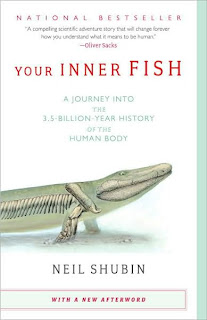
Your Inner Fish: A Journey into the 3.5-Billion-Year History of the Human Body, a book with a rather curious title, traces our shared lineage with other organisms going back hundreds of years to our aquatic ancestors. Its author, Neil Shubin was a member of the team that, in 2006, discovered the purported missing link between fish and terrestrial tetrapods. It was a paleontological breakthrough that fascinated academics and laypersons alike (links: Nature and New York Times). The 375 million year old fossilized animal, excavated from the Canadian Arctic exposures, was named Tiktaalik, or "large freshwater fish" in the Inuktitut language. As a paleontologist who taught anatomy to university students, Shubin has written this wonderful book which helps us understand anatomy in light of our shared descent with the rest of the animal kingdom. According to him:
The best road maps to human bodies lie in the bodies of other animals. The simplest way to teach students the nerves in the human head is to show them the state of affairs in sharks. The easiest road map to their limbs lies in fish. Reptiles are a real help with the structure of the brain. The reason is that the bodies of these creatures are often simpler versions of ours. 
Book review: Your Inner Fish by Neil Shubin

Tuesday, September 04, 2012

Wildlife Safari

I have been looking for an excuse to revisit the San Diego Zoo Safari Park for a while. My renewed interest in this place was spurred by the knowledge of it being home to the only two surviving Northern White Rhinos in the world (a species I got particularly attached to after reading Douglas Adams' book Last Chance to See and watching the follow-up BBC documentary shot 20 years after the book). My PowerShot SX40 HS, which has been sitting practically unused since purchase, gave me that excuse I needed to make this long overdue visit finally happen. The SX40 is a high-end, super-zoom point-and-shoot. Most of my captures are of either distant or moving targets. 
African lion at Lion Camp enjoying his siesta

Monday, September 03, 2012

Of Megafauna And Men

During the Pleistocene epoch, colossal relatives of many familiar present-day creatures roamed the earth. Some of these formidable megafauna species vanished abruptly (in what paleontologists like to call blitzkriegs) while some faded out gradually. Once and Future Giants: What Ice Age Extinctions Tell Us About the Fate of Earth's Largest Animals by Sharon Levy is a safari through the Pleistocene and the (ongoing) Holocene epochs acquainting us with behemoths then and now. In the author's own words:
This book tells the story of the megafauna and us. It is a tale of human coexistence and clashes with giant animals, past and present, and our responsibility toward them in the future.
Just as the struggles of surviving megafauna offer clues about how and why their lost cousins perished, Pleistocene extinctions offer lessons that can be critical for the conservation of megafauna living today. 

Book review: Once and Future Giants by Sharon Levy

Wednesday, August 29, 2012

The Garden Canvas

The Meadowlark Botanical Gardens were quite a treat for my humble little point-and-shoot. I found this place to be perfectly charming with its uncountably many shades of green, formidable expanse, curious decor and artwork, and eclectic collection of visitors (including flyers, swimmer, crawlers, and of course walkers)! Without further ado, here are some captures.
The caterpillar and the ladybug share arboreal real estate

Saturday, August 11, 2012

The Language Wars

A language is a transcript of history, not an immutable edifice. 
And yet people continue to quibble and bicker about what qualifies as "proper" English. While the wars wage in full flourish, we continue to struggle with the unavoidable and confusing baggage of grammar, spelling, punctuation, pronunciation, and vocabulary. In his book, The Language Wars: A History of Proper English, Henry Hitchings makes the horrors of the English language a tad less horrifying by helping us understand it better from a historical and geographical standpoint.

Book review: The Language Wars by Henry Hitchings

Saturday, July 21, 2012

What Lies Beneath


While philosophers and scientists have been trying to unravel the mysteries of the human psyche since time immemorial, the focus has generally been on the conscious mind. It is only over the last couple of centuries or so that the significance of unconscious mental processes began to be truly appreciated. While this revelation has given new directions to neuroscience, medicine, and psychology, its influence extends beyond the frontiers of science. Artists from different schools (mannerism, impressionism, modernism, and expressionism, to name a few) have knowingly or unknowingly exploited the observer's unconscious to create evocative masterpieces. In his book The Age of Insight: The Quest to Understand the Unconscious in Art, Mind, and Brain, from Vienna 1900 to the Present, neuroscientist and Nobel laureate Eric Kandel tells an intriguing story about how the unconscious, for the first time, came to be the focal point of a cultural movement in Vienna of the 1900s and provides a scientific treatise on the inner workings of the brain as it creates art or responds to it. What unified the artistic and scientific endeavors of fin de siècle Vienna was the general propensity toward looking beneath the surface for hidden answers and deeper truths, a practice that was to have a long-lasting influence on science and art.

Book review: The Age of Insight by Eric Kandel